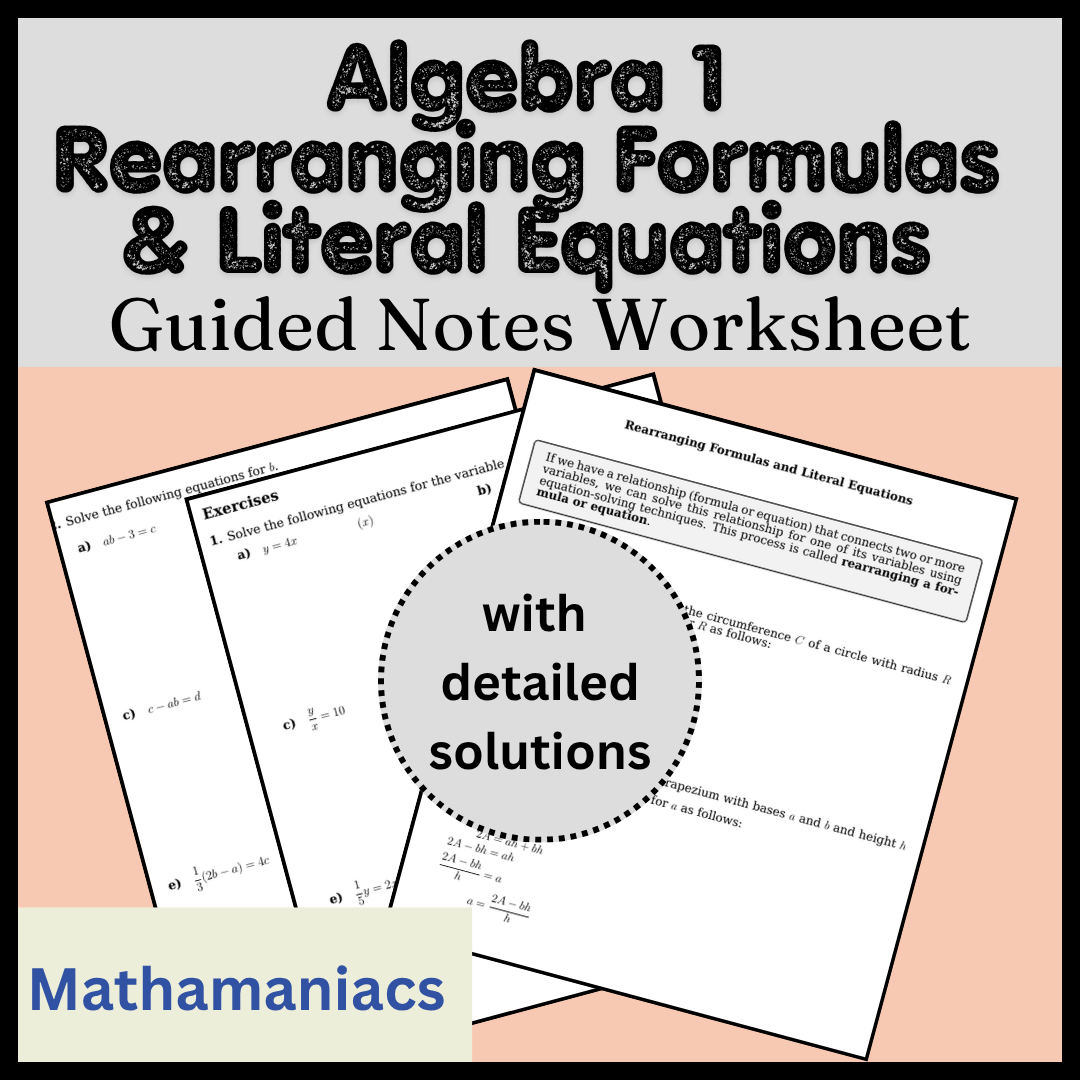
Algebra 1 Rearranging Formulas & Literal Equations Guided Notes Worksheet
Notes and worksheet on rearranging formulas and literal equations.
In the notes, detailed examples of solving literal equations are included.
In the worksheet, a large number (7 pages) of practice problems are included.
Some of the equations in the exercises involve fractions, brackets or the variable to solve for on both sides.
Detailed solutions to all problems are included.
Are you looking for a no-prep way to teach rearranging formulas and solving literal equations? This comprehensive guided notes and practice packet is perfect for introducing the concept, classroom practice, homework, or high school algebra review!
Many worksheets only feature basic two-variable problems. This resource challenges your students with real-world geometric formulas, formula matching columns, and multi-variable parameter tables that build a deep mathematical understanding of inverse operations.
🌟 What is Included?
- 2 Pages of Guided Notes & Examples: Step-by-step walkthroughs demonstrating how to rearrange foundational geometric formulas like circle circumference and trapezium area.
- 7 Full Pages of Student Practice: Over 40 carefully scaffolded algebra problems ranging from simple single-step isolation to advanced multi-variable challenges.
- Full Step-by-Step Solutions: Complete teacher answer keys showcasing every single algebraic step and transformation for quick grading or student self-assessment.
🧩 Types of Problems Covered
- Scaffolded Variable Isolation: Solving multi-variable equations for a specifically requested variable in brackets.
- Formula Matching Activity: Connecting equivalent rewritten formulas across two columns to test conceptual manipulation skills.
- Geometric Application Tables: Rearranging the formulas for the area of a triangle and the surface area of a cuboid, then substituting real dimensions to solve for missing heights, lengths, and widths.
- Multi-Step Variable Grouping: High-level literal equations requiring advanced factoring, fraction clearing, and distribution to isolate the target variable.
💻 Perfect For:
- Core classroom instruction and guided notes
- Independent desk work or partner practice
- Homework assignments or quiz prep
- Emergency, hassle-free substitute teacher lesson plans