Dividing Polynomials by Long Division Worksheet | Algebra 2 No Prep Practice
On Sale
$1.40
$1.40
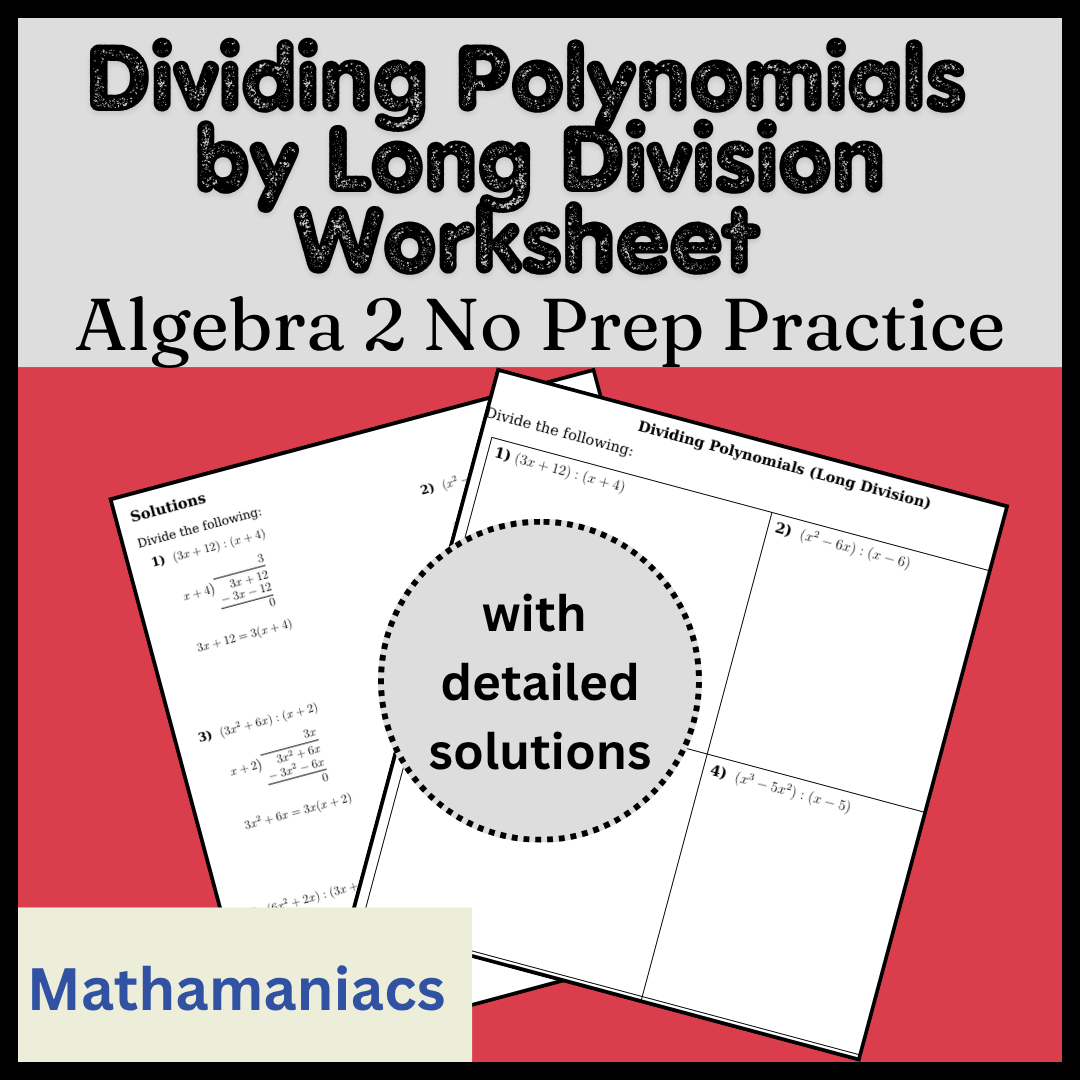
A worksheet on dividing polynomials using long division. There are 18 divisions to do, with or with no remainder. Detailed solutions are included.
Dividing polynomials using long division can be a challenging concept for students to master. This print-and-go worksheet takes the stress out of your lesson planning by providing a structured practice guide. It moves students smoothly from simple division with no remainders to complex problems featuring larger polynomials and remainders, making it the perfect resource for classwork, homework, or an easy sub plan.
🌟 What is Included in This Resource?
- Comprehensive Practice Worksheet: A wide range of carefully scaffolded problems organized neatly across a multi-page layout. Students will divide multi-term polynomials by binomial expressions using the long division method.
- Generous Workspace: Each problem is housed in a large, clean box, giving your students plenty of space to set up their long division symbols, align terms, and write out every step of their working.
- Step-by-Step Answer Key: A complete, fully worked-out solution guide showing the exact long division process for every single problem. This makes grading a breeze for you, or allows students to easily self-check their work.
🎯 Why Teachers Love This Worksheet
- No-Prep Printables: Simply download, print, and you are instantly ready to teach!
- Carefully Scaffolded: Helps students build confidence as the problem difficulty gradually increases from basic binomial divisors to equations requiring remainders.
- Flexible Use: Ideal for a standalone lesson, independent practice, homework, test revision, or math centers.
📐 Educational Standards Covered
- Common Core State Standards (CCSS):
- HSA-APR.B.2: Know and apply the Remainder Theorem.
- HSA-APR.D.6: Rewrite simple rational expressions in different forms by using long division.
- Texas TEKS Standard:
- Algebra 2 (2A.7C): Determine the quotient of polynomials when divided by polynomials of degree one and degree two.