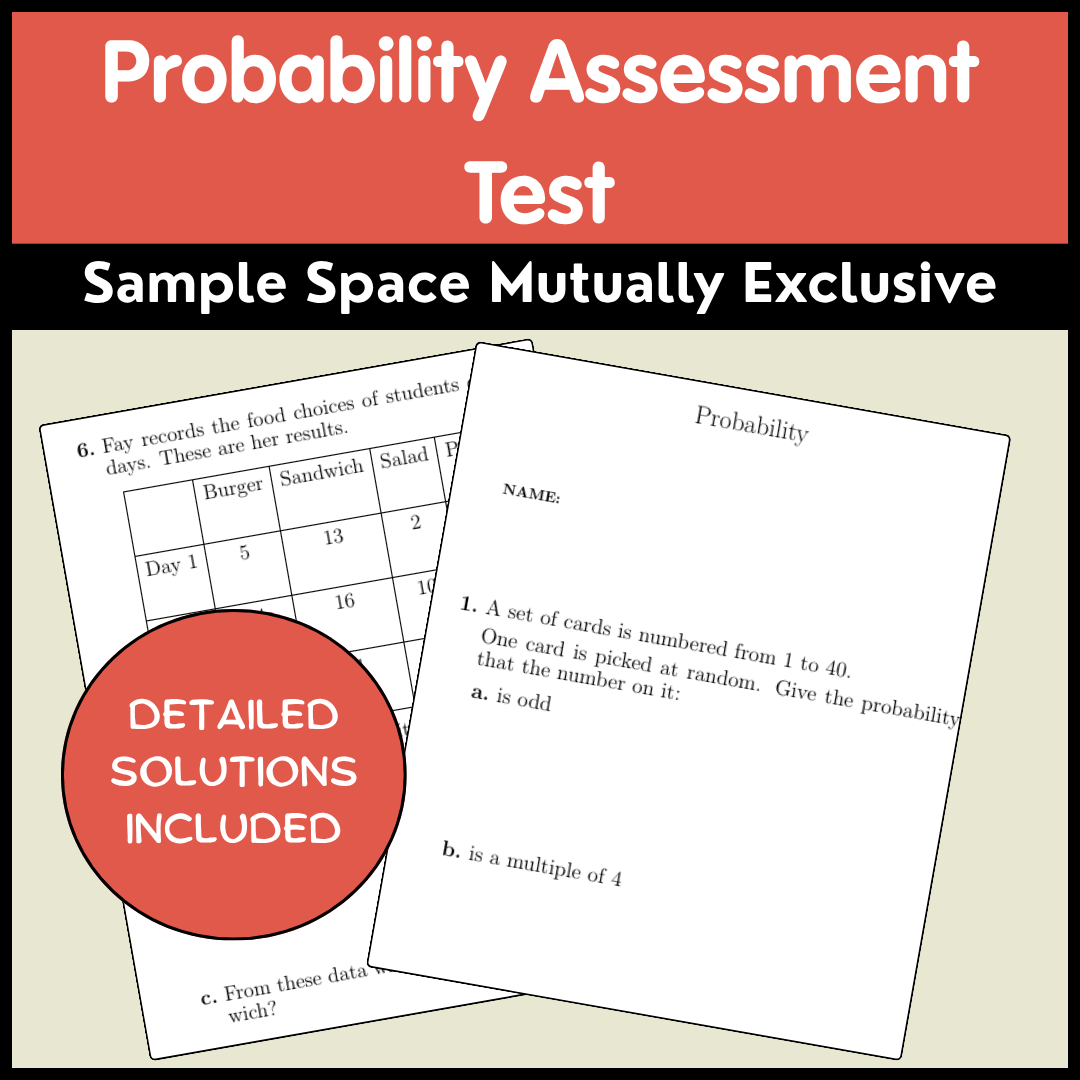
Probability Assessment Test | Sample Space Mutually Exclusive
On Sale
$1.50
$1.50
Assess and reinforce your students' mastery of theoretical and experimental probability with this comprehensive, ready-to-print assessment test and full answer key.
This resource features a complete test covering single-event probabilities, word problems with changing item counts, color likelihood ratios (fractions, decimals, percentages), mutually exclusive events, compound probability using sample space diagrams, and experimental relative frequency analysis. Full step-by-step solutions with mark allocations are included for easy grading or self-assessment.
What is Included:
• 1 Printable Assessment Test (6 structured core questions, total 35 marks)
• 1 Detailed Solution & Answer Key with step-by-step working out
Key Topics Covered:
• Single-event card probabilities (odd, multiples, factors, primes, squares)
• Word problems with changing sample sizes
• Probability in multiple formats (fractions, decimals, percentages)
• Identifying mutually exclusive vs non-mutually exclusive events
• Constructing sample space tables for compound events (cards & coin flips)
• Experimental probability, relative frequency, and data reliability
Aligned Standards: CCSS 7.SP.C.5, 7.SP.C.6, 7.SP.C.7, 7.SP.C.7a, 7.SP.C.8, 7.SP.C.8a